
THE CHALLENGE
Breaking Research Data Silos
The University Hospital Cologne (UKK) Medical Data Integration Centre (MeDIC) sought to eliminate manual data entry and latency in clinical research. For high-stakes research, specifically within the ERKER Rare Disease project, data was captured in REDCap. However, this data remained siloed from the hospital’s centralized FHIR-native infrastructure. The goal was to establish a real-time, standards-based synchronization between complex REDCap instruments and the hospital’s FHIR-based clinical data repository to support longitudinal research and cross-institutional sharing.
THE SOLUTION
Deploying the Ignifyr REDCap Integration Module
We utilized Ignifyr to develop and deploy a specialized integration layer that automates the flow of research data into the HL7 FHIR® ecosystem. This project utilized the ERKER v13, a comprehensive Rare Disease data model, to validate the end-to-end synchronization.
Automated Research Ingestion & Schema Generation
Within the Ignifyr environment, we implemented a specialized module that interacts directly with the REDCap API to automate the transformation process:
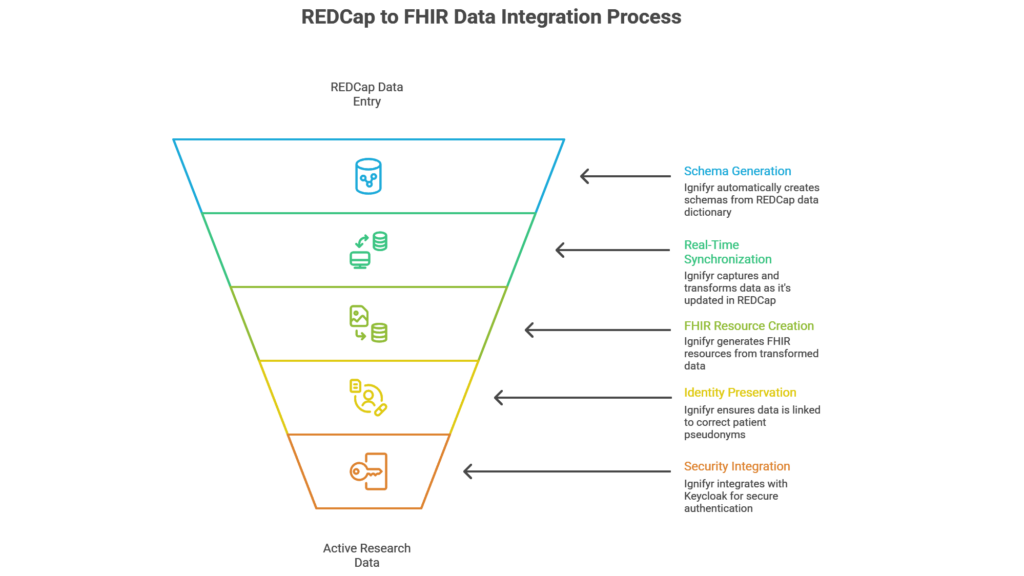
- Dynamic Schema Generation: We utilized Ignifyr’s schema generation functionality to automatically create source schemas based on the REDCap Data Dictionary. This ensures that any changes to the REDCap forms are reflected in the data integration pipeline without manual reconfiguration.
- Real-Time Synchronization: We configured Ignifyr to utilize REDCap’s Data Entry Triggers. The moment a researcher completes or updates a form, Ignifyr automatically captures the event, transforms the data with respect to the developed mappings, and persists generated FHIR resources into a Firely FHIR Server instance.
Specialized Rare Disease Workflows
The solution was validated through the implementation of the complex ERKER Rare Disease mapping, which required a deep understanding of multi-resource clinical modeling:
- Multi-Resource Mapping: Utilizing Ignifyr’s advanced transformation logic, we developed mapping definitions to generate a cohesive bundle of FHIR resources from a single REDCap instrument, including Patient, Observation, Encounter, Condition, Procedure, and FamilyMemberHistory.
- Identity Preservation: By utilizing Ignifyr’s identity service capabilities, we ensured that data flowing from the research environment was accurately linked to the correct patient pseudonyms within the clinical repository.
Enterprise Security and Authentication
To ensure the system met the rigorous security requirements of the MeDIC environment, we integrated the pipeline with the hospital’s security infrastructure:
- Keycloak Integration: We utilized Ignifyr’s security configuration to support OAuth 2.0 authentication via Keycloak. This ensures that the integration module communicates securely with the Firely FHIR Server using scoped access tokens.
- Audit-Ready Logging: Every transformation and ingestion event is logged within Ignifyr, providing the transparency required for clinical research governance.
THE ımpact
From Static Forms to Active Research Data
The deployment at UKK MeDIC transformed clinical research from a disconnected activity into an integrated component of the hospital’s data strategy.
- Operational Efficiency: Eliminated manual batch exports, providing researchers with real-time access to standardized FHIR data directly within their analysis tools.
- High-Fidelity Research Data: The hospital ensured that complex rare disease indicators are natively compliant with international standards from the point of capture.
- Staff Empowerment: We delivered hands-on training and detailed documentation to the UKK team, enabling them to independently configure new REDCap-to-FHIR ETL routes for future research projects.
SEE OUR PACKAGES
Do you want to integrate your research data with FHIR?
Explore our packages to learn how we help healthcare organizations integrate REDCap and other research platforms into FHIR-based infrastructures. Or contact us to discuss your research data integration needs.
STARTER PACK
FHIR Foundation Pilot
The FHIR Foundation Pilot is a fixed-scope engagement designed to prove value quickly.
We take one of your real-world data sources and transform it into a high-quality, usable HL7 FHIR® API—giving you a working blueprint for your entire ecosystem.
STARTER PACK
MII Readiness Engagement
The Strategic Foundation for Your DIZ
Establish a validated, KDS-compliant data pipeline in 8–12 weeks. This fixed-scope engagement moves you from raw clinical data to a research-ready asset, providing the technical blueprint and institutional governance documentation required to kickstart your secondary-use strategy.